Abandoned Cart Email Basics: What to Say : For Beginners de
Why abandoned cart emails matter
A lot of cart recoveries do not need a dramatic sales message. They need a simple reminder.
People leave carts for all kinds of ordinary reasons. They get distracted. They want to compare options. They are waiting until payday. They need a little more time to think about shipping, returns, or whether the item is the right fit. That does not always mean the sale is gone.
For a small online store, abandoned cart emails can help bring people back without making the brand sound desperate. The best ones usually do not push harder. They reduce friction, answer quiet questions, and make the next step easy.
That is why this kind of email works best when it feels calm. You are not trying to corner someone into buying. You are reminding them what they left behind and giving them a simple path back if they are still interested.
What an abandoned cart email should actually do
A good abandoned cart email is not there to guilt the customer. It is there to help them continue where they left off.
That means the message should do a few clear things:
- remind them what they were looking at
- make it easy to return to the cart
- reduce hesitation if trust or clarity is the real issue
- keep the tone friendly and low-pressure
A lot of small stores make the mistake of treating cart emails like emergency promotions. The copy gets loud, the discount gets big, and the whole email starts sounding like the shopper did something wrong by leaving. That usually does not help.
A calmer email often works better. A short reminder, a useful line about the product, and a clear button back to the cart is enough for a first version.
This is especially true when the store is new. A smaller brand often needs to build trust before it pushes urgency. If the email sounds too intense too fast, it can feel off.
A simple cart recovery sequence for a small store
For many small online stores, a two- or three-email sequence is enough. You do not need a huge automation flow to start.
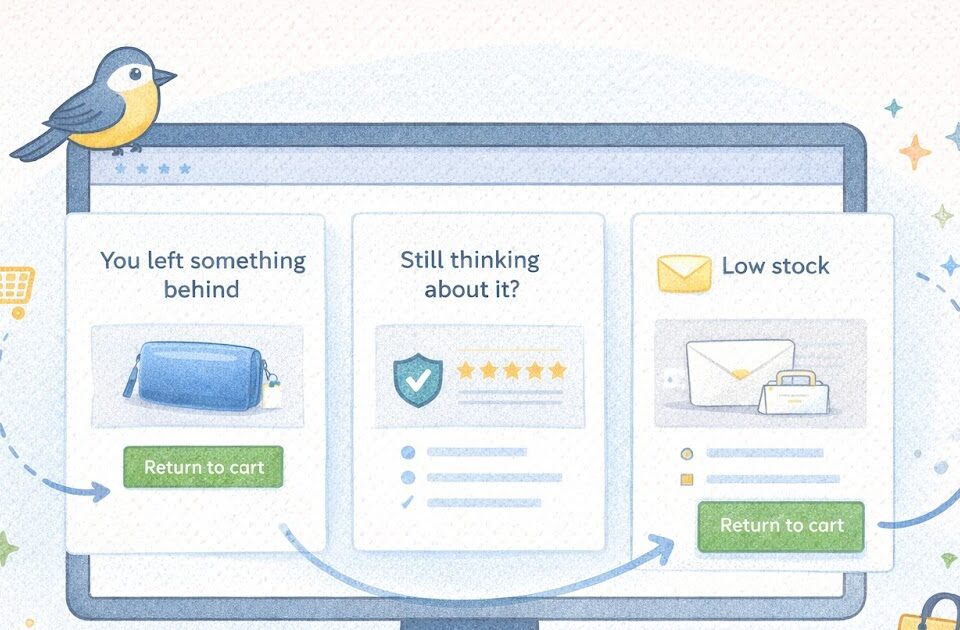
Email 1: The reminder
This is the most important one. It usually goes out after a short delay, often within a few hours to a day depending on the store and platform.
Its job is simple:
- remind the shopper they left something behind
- show the product clearly
- give them one easy button back to the cart
The tone should stay light. Something like: “You left something in your cart.” or “Your cart is still here.”
The body copy can stay short: “If you were still thinking it over, your cart is ready when you are.”
That works because it feels neutral. No pressure. No weird drama.
Email 2: The reassurance email
This one can come a day or two later if the cart is still abandoned. Its job is to reduce hesitation.
This is a good place to add one or two trust cues, such as:
- shipping timing
- return basics
- product reviews
- a quick reminder of what makes the item useful
For example, if you sell candles, this email might remind the shopper about burn time, scent profile, and shipping speed. If you sell bags, it might mention size, material, and return basics.
The message should still be simple: “Still thinking about it? Here are a few details that may help.”
That feels more useful than pushy.
Email 3: The last nudge
If you use a third email, keep it gentle. This can be a final reminder, a note about low stock if that is genuinely true, or a small incentive if discounts are part of your store strategy.
The important word there is genuinely. Do not invent urgency. A made-up “last chance” tone can damage trust faster than it helps.
A good final email might say: “If you still want it, your cart is ready.” or “A quick reminder before your cart expires.”
If you choose to include an offer, keep it light and avoid training people to abandon carts just to get a discount.
A simple timing example
- Email 1: a few hours after cart abandonment
- Email 2: 1 day later
- Email 3: 2 to 3 days after that
That is enough for most small stores.
What to say without sounding pushy
This is where tone matters most. A shopper who left the cart is already uncertain, distracted, or not ready. If the email sounds aggressive, it adds friction instead of removing it.
The easiest fix is to write like a helpful person, not like a countdown banner.
A few tone shifts help:
- use reminders instead of pressure
- use product clarity instead of hype
- use trust details instead of repeated urgency
- use one clear call to action instead of multiple pushes
Better message angles
- “Here’s what you were looking at”
- “Your cart is ready when you are”
- “A few details in case you were still deciding”
- “Easy returns and straightforward shipping”
- “Start where you left off”
These all sound calmer than:
- “Don’t miss out”
- “Act now”
- “Your chance is almost gone”
- “Final warning”
That kind of language can work in some contexts, but for many small stores it sounds louder than the brand needs to be.
A good abandoned cart email also helps when the real issue is missing information. Maybe the customer wanted to know how long shipping takes. Maybe they were unsure about return policy. Maybe they needed a little more confidence in the product. If the second email answers one of those questions, it can do more than a discount ever would.
Practical steps
- Keep each email focused on one job.
- Use a clear subject line that sounds natural.
- Show the product or cart item clearly.
- Add trust or product details in the second email.
- Use one strong button back to the cart.
This is also one place where design can stay simple. A product image, a few lines of copy, and one call to action is often enough.
Common abandoned cart mistakes to avoid
One common mistake is sending too many emails too quickly. That can make the store feel noisy, especially if the shopper only needed a little time.
Another issue is using urgency before the brand has earned it. If every message says “last chance” or “don’t miss out,” the emails start sounding generic. Worse, they may feel dishonest if the product is still there days later.
A third problem is forgetting the real reason people leave carts in the first place. Sometimes it is price, yes. But often it is uncertainty. That means better copy, better trust cues, or better product details may help more than a bigger offer.
Common mistakes
- sending too many reminders
- making the tone too aggressive
- repeating the same message in every email
- using fake urgency
- making the discount the only strategy
- forgetting to answer likely customer questions
There is also the issue of weak subject lines. If every subject line sounds like a promo blast, open rates can drop. Clear usually works better than clever here.
A simple example: “Still thinking it over?” often feels more human than “Your final chance to save.”
A quick cart email checklist summary
Quick checklist
- [ ] The first email sends as a simple reminder
- [ ] The product left in the cart is clearly shown
- [ ] The tone feels calm, not pushy
- [ ] The second email adds useful trust or product details
- [ ] The call to action leads back to the cart clearly
- [ ] Any urgency used is real, not invented
- [ ] Discounts are optional, not the whole strategy
- [ ] Subject lines sound natural and readable
- [ ] The sequence is easy to scan on mobile
- [ ] The emails match the store’s tone and trust level
If several of these basics are missing, the sequence may still be live, but it is probably leaving recoveries on the table.
Keep it helpful, then improve from there
A strong abandoned cart sequence does not need to sound clever. It needs to sound useful.
For a small online store, the best first version is often simple: one reminder, one reassurance email, and maybe one final nudge if it fits the brand. That gives you room to bring people back without turning the inbox experience into pressure.
Once the sequence is running, you can improve it based on real behavior. See which email gets clicks. See whether the second message helps more than the first. See whether trust details or product clarity make a difference. That kind of learning is easier when the first version is clean.
Gentle next step
Draft your first abandoned cart email with one question in mind: what would help this shopper continue without feeling pushed? Start there. Then build the second email around one useful reassurance, not a louder pitch. Sin estres. Helpful cart emails usually outperform pushy ones over time.
FAQs
Q1. How many abandoned cart emails should a small store send?
A1. For many small stores, two or three emails are enough. That gives you room to remind, reassure, and gently follow up without overdoing it.
Q2. Should every cart email include a discount?
A2. No. A discount can help in some cases, but many carts can be recovered with a reminder and clearer trust details instead.
Q3. What should the first abandoned cart email say?
A3. Usually just a simple reminder. Show the item, remind the shopper their cart is still there, and give them an easy path back.
Q4. How do I avoid sounding pushy?
A4. Keep the tone neutral and helpful. Focus on reminders, product clarity, and trust details instead of constant urgency or pressure.