Simple SEO Content Ideas for Online Stores : For Beginners de
Store content does not need to be fancy to be useful
A lot of small store owners hear “SEO content” and picture a huge blog plan, complicated keyword tools, or a publishing calendar they will never keep up with. That usually leads to one of two outcomes: either nothing gets published, or random posts go live with no clear purpose.
A better approach is simpler. Create content that helps real shoppers answer real questions before they buy. For most online stores, that usually means a few strong guides, a practical FAQ, and some honest comparison posts.
That lines up with Google’s current guidance. Google says helpful, reliable, people-first content should be created to benefit people, not just to manipulate rankings, and its SEO starter guidance recommends using words people would actually search for in places like page titles, headings, alt text, and link text. :contentReference[oaicite:0]{index=0}
For a small ecommerce business, that is good news. You do not need 50 articles. You need a few useful ones that match the questions your customers already ask.
Why simple SEO content works better than random posting
Small stores often publish content backwards. They start with a broad topic like “summer trends” or “why quality matters,” then hope traffic appears. The problem is that those posts are usually too vague, too competitive, or too disconnected from what shoppers actually need.
Google’s guidance is more practical than that. It says to create helpful, reliable, people-first content, keep it unique and up to date, and think about the words different users might search for, including beginners who may use simpler terms than experts. :contentReference[oaicite:1]{index=1}
For an online store, this usually points to content that sits close to buying decisions:
- how to choose the right product
- what size or option fits best
- what the differences are between two versions
- what happens after someone orders
- what common problems or questions come up before purchase
That kind of content helps in two ways. It can bring in search traffic over time, and it can reduce support questions because shoppers get clearer answers before they email you.
A natural example: a small candle shop might not need a broad post on “home fragrance inspiration.” It may get more value from a post like “Soy vs Beeswax Candles: What’s the Difference for Small Spaces?” That is more specific, more useful, and closer to purchase intent.
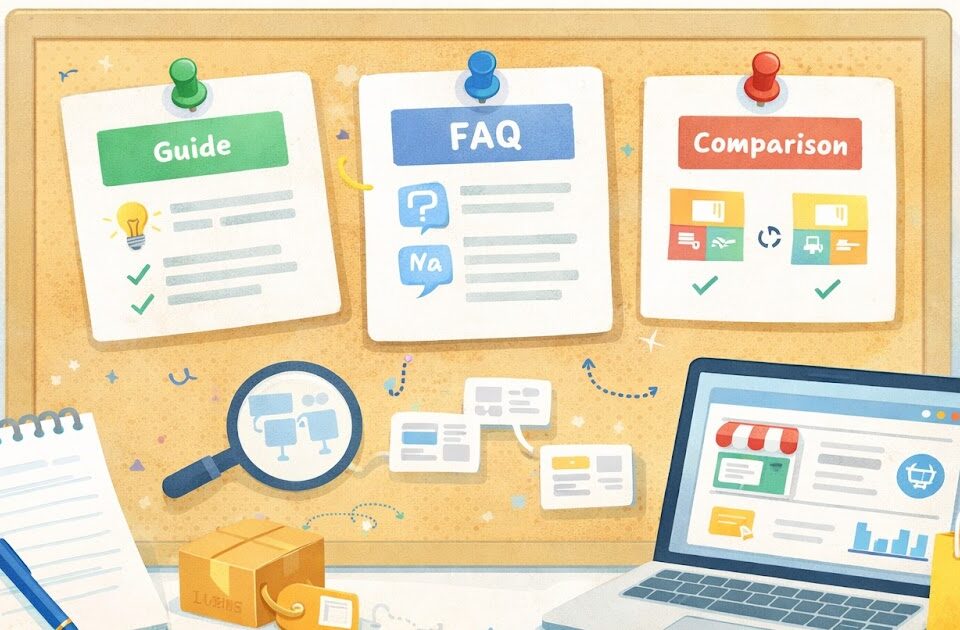
Three content formats that fit small online stores
You do not need endless formats. Start with the three that are easiest to maintain and easiest for shoppers to use.
1. Guides
A guide helps a shopper make a decision or solve a simple problem.
Good guide topics for stores often sound like:
- How to choose the right candle size for a small room
- Beginner’s guide to matching coffee grinders to brew method
- What to look for in a laptop sleeve for travel
- How to pick the right dog harness size
These work because they answer a practical question with a clear next step. Google’s SEO documentation also recommends making your links crawlable so search engines can discover related pages on your site, which means a guide can naturally link to products, FAQs, and related collection pages. :contentReference[oaicite:2]{index=2}
2. FAQs
An FAQ is one of the easiest wins for a small store. It helps you turn repeated customer questions into useful content.
Good FAQ topics usually come from:
- shipping questions
- returns or exchanges
- sizing or fit
- materials and care
- compatibility
- timing, stock, or customization
This format is simple, but it works because it matches real customer language. Google’s guidance says to use the words people would use to look for your content, and FAQ-style questions often do that naturally. :contentReference[oaicite:3]{index=3}
3. Comparisons
A comparison post helps shoppers decide between two options without feeling pushed.
Examples:
- Ceramic mug vs insulated tumbler for daily commuting
- Reed diffuser vs candle for small apartments
- Matte phone case vs clear case for grip and wear
- Lightweight blanket vs weighted blanket for warm climates
This format works best when it is balanced. Say who each option is for, what the trade-offs are, and when not to choose one. That is more useful than pretending one option wins for everyone.
How to come up with content ideas without overthinking it
The easiest content plan is usually already sitting in your inbox, order notes, and customer chats.
Start with three simple sources:
Customer questions
Look at the questions you answer repeatedly. Those are strong content candidates because they already reflect real demand.
Product decision points
Ask where customers hesitate before buying. Size, materials, compatibility, use case, care, and shipping timing are common friction points.
Comparison moments
Notice where people are deciding between two products, styles, bundles, or materials. Those moments are content opportunities.
A simple workflow looks like this:
- Pick one product category.
- List the top 10 questions customers ask.
- Group them into guide, FAQ, or comparison formats.
- Publish the ones closest to purchase intent first.
- Link them to the right product or category pages.
Easy idea starters for small stores
- Guide: how to choose, how to use, how to care for, what size to buy
- FAQ: shipping, returns, fit, ingredients, setup, compatibility
- Comparison: this vs that, beginner option vs premium option, indoor vs outdoor use
A good rule here is to write for the customer who is one step away from buying, not for a general audience who may never need your product.
Common mistakes that make store content harder to rank and harder to trust
The first mistake is writing for search engines instead of people. Google’s people-first guidance is explicit about this: content should be created to help people, not primarily to manipulate search rankings. :contentReference[oaicite:4]{index=4}
The second mistake is choosing topics that are too broad. “Best gift ideas” is usually too wide. “Best gift-ready candle sizes for under $35” is more useful and more realistic for a small store.
The third mistake is writing posts that never connect back to products or category pages. If someone reads your guide and has no obvious next step, the content may attract views but not help the business much.
The fourth mistake is publishing thin posts just to “stay active.” Google’s starter guide says content should be unique and helpful, not copied or lightly rehashed. :contentReference[oaicite:5]{index=5}
Quick reality checks
- Too broad: hard to rank, vague for shoppers
- Too salesy: lower trust, less useful
- Too thin: low value, easier to ignore
- Too disconnected from products: traffic with no business outcome
Quick checklist summary
Quick Checklist
- [ ] Start with customer questions, not random topics.
- [ ] Use simple formats like guides, FAQs, and comparisons.
- [ ] Pick topics close to purchase decisions.
- [ ] Use words shoppers would naturally search for.
- [ ] Keep titles clear and specific.
- [ ] Link each piece to relevant products or collections.
- [ ] Update posts when product details or policies change.
- [ ] Avoid publishing filler just to have “more content.”
What to do next
Pick one product category this week and keep it simple.
Write:
- one short buying guide
- one FAQ post based on real customer questions
- one honest comparison between two common options
That is enough to start building useful store content without turning SEO into a giant project. For most small ecommerce teams, consistency beats volume. A few helpful posts that answer real questions can do more than a pile of generic articles no one remembers.
Common questions
Q1. Do online stores need a blog to do SEO well?
A1. Not always, but many stores benefit from having a few useful content pages that answer buying questions. The goal is not “having a blog.” The goal is helping shoppers find and understand what they need.
Q2. Which content type should I start with first?
A2. Start with the format closest to your customer questions. For many small stores, that is an FAQ or a buying guide.
Q3. How often should I publish SEO content?
A3. A realistic pace is better than an ambitious one you cannot maintain. One solid post a month can be more useful than four rushed posts.
Q4. Should comparison posts always favor my higher-priced product?
A4. No. Balanced comparisons build more trust. Explain the trade-offs clearly and let the better fit be the better fit.
Suggested External Links
References
- Google Search Essentials and SEO Starter Guide :contentReference[oaicite:6]{index=6}
- Google guidance on creating helpful, reliable, people-first content :contentReference[oaicite:7]{index=7}