Why Boring Suburbs Are the New Luxury in Australia : For Beginners de
The postcode flex is getting expensive
Australia still talks about suburbs as if coolness is a housing strategy. People will forgive a brutal commute, a $7 flat white, and a supermarket that feels like a boutique museum, as long as the postcode sounds impressive at a dinner table.
That logic made more sense when money was looser and housing did not feel like a weekly exam. It makes less sense now. A suburb that is plain, functional, and slightly uncool can quietly save you hundreds each month in fuel, takeaway spending, parking, delivery fees, and stress.
That is why boring suburbs are starting to look like luxury. Not luxury in the glossy real estate brochure sense. Luxury in the modern Australian sense, where your rent or mortgage does not swallow your mood, your errands do not require military planning, and you can get through a Tuesday without resenting your own address.
Why “boring” started winning
- Core claim: In Australia, the new housing luxury is not always the prettiest suburb, it is the suburb that makes ordinary life cheaper and easier.
- What people get wrong: They confuse prestige with value and aesthetic appeal with practical living.
- Why it matters: Housing costs spill into transport, food, childcare, time, and mental bandwidth.
- Who this affects: Renters, first-home buyers, young families, and anyone trying to cut living costs without feeling deprived.
- Bottom line: A suburb can be deeply unsexy and still be a better life decision.
The smarter suburb test is not glamour, it is friction
The common housing script says the dream suburb is trendy, beautifully branded, close to cultural hotspots, and full of places that look good on Instagram. That script is not harmless. It pushes people to pay extra for an identity package when what they often need is a suburb that works on a boring Wednesday.
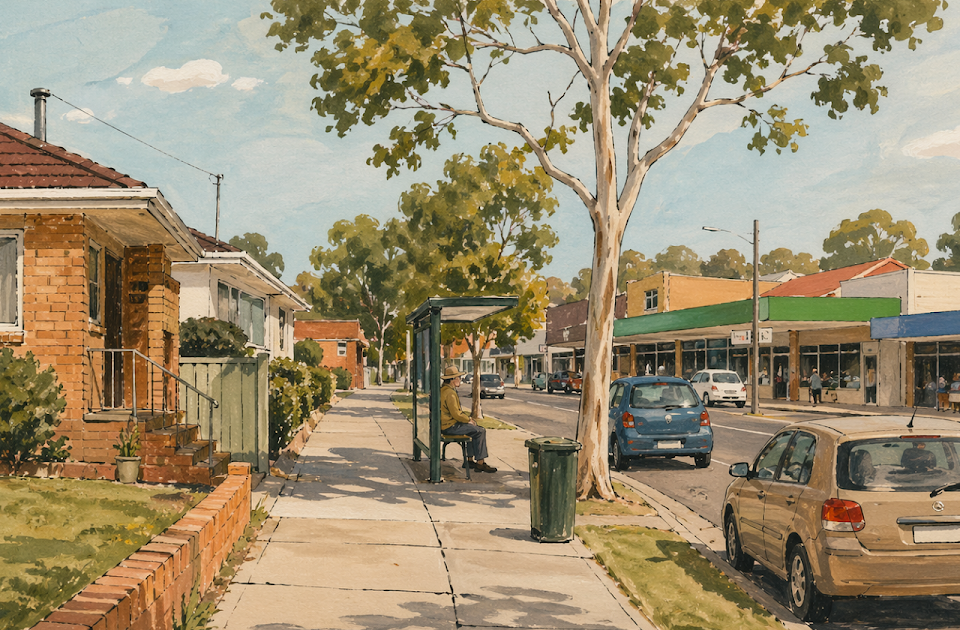
A functional suburb usually wins in small, repeatable ways. The chemist is nearby. The grocery shop is simple. Parking is not a blood sport. The local high street is not fashionable, but it does the job. The train station, bus route, or road access is good enough that one delayed service does not wreck the day.
The myths that still trap people
- The best suburb is the one people brag about.
- Paying more usually means living better.
- If a place looks a bit dull, it must be a compromise.
What actually matters more
- The best suburb for cost of living is often the one that reduces daily friction, not the one with the best reputation.
- Paying slightly less for a less exciting postcode can free up cash and time in ways people underestimate.
Why this misunderstanding keeps spreading
- Real estate language rewards aspiration, not realism.
- Lifestyle media often treats charm as if it pays bills.
- People judge suburbs from weekend impressions, even though most of life happens on ordinary weekdays.
What people miss when they chase “nice”
- Daily costs compound: A suburb that forces constant driving, expensive cafes, and premium groceries can quietly inflate your budget even if the rent difference looks manageable.
- Time is part of housing value: A shorter, simpler week is a real asset, especially for households juggling school runs, shift work, or split schedules.
- Ease beats status: If the suburb lets you do the basics quickly, it can feel richer than a fashionable area that drains cash and patience.
Here is the part people do not love hearing. A suburb does not need personality to deliver quality of life. It needs useful stuff in the right places. The Australian housing market has trained people to look upmarket first and practical second, but the order should often be reversed.
That does not mean every outer or quieter suburb is automatically a bargain. Some cheaper-looking areas punish you later with poor transport, patchy services, or a car dependency so intense it eats the savings. “Boring” only works when it is also functional. A cheap suburb that turns every errand into a 40-minute mission is not value, it is delayed payment.
The housing fantasy is not dead, it is just less convincing now
Australia’s housing affordability problems did not disappear because some mortgage rates eased. That matters because many households are still making suburb decisions under pressure, not from a position of abundance. When housing remains tight, the “dream postcode” story starts to look less like aspiration and more like self-inflicted admin.
This is where the boring suburb begins to shine. It often offers a quieter version of abundance. Maybe the high street is ugly. Maybe nobody writes glowing think pieces about it. Maybe the local cafe scene is a touch too earnest or a touch too beige. Fine. If it has a decent supermarket, reliable basics, a school option, a serviceable park, and sane travel patterns, it may be doing more for your life than a prettier suburb that performs status but delivers stress.
A lot of households now need suburbs that support containment. Contained fuel use. Contained rent or mortgage pain. Contained chaos. A place where you are not tempted to spend every time you leave the house can be a financial advantage. A place where convenience does not come with a premium identity tax can be even better.
Trade-offs that are worth being honest about
- Not all boring suburbs are equal: Some are practical gems, others are cheap-looking but badly connected. The details matter.
- Charm still has value: Walkability, local culture, and public life matter. The point is not to reject them, it is to stop pretending they are free.
A better way to judge a suburb now
- Ask what the suburb saves you: Time, fuel, delivery spending, parking stress, childcare coordination, or impulse spending.
- Ask what the suburb forces you to buy: Extra car use, premium groceries, convenience food, private alternatives, or long commutes.
Scope note
- Census travel and work-from-home figures are useful context, but they reflect a snapshot rather than the full texture of daily life in every suburb.
- What stays true: Everyday convenience still shapes household budgets.
- What varies: The balance between price, transport, and amenity changes sharply by city, region, and household type.
What this means if you are choosing where to live
If you are renting, buying, or even just daydreaming about moving, stop asking whether a suburb is exciting. Ask whether it is forgiving. A forgiving suburb is one that makes small mistakes less expensive. You miss the bus, fine, there is another option. You need milk, scripts, and a school pickup in one hour, still manageable. You are tired on Thursday, the suburb does not force you into another overpriced convenience decision.
That is the new luxury, not spectacle, but slack. Not prestige, but margin. Not the suburb that impresses people who visit twice a year, but the one that behaves well for the people living there every day.
Australian housing culture still likes the performance of taste. The smarter move now is to look for the performance of function. The suburb that seems boring on Saturday afternoon may be the one that gives you your week back. That is not settling. That is finally pricing life properly.
FAQ
Q1. Does this mean expensive inner suburbs are never worth it?
A1. No. Some expensive suburbs genuinely deliver strong transport, amenities, walkability, and time savings. The point is that many people pay for brand value first and practical value second, when it should usually be the other way around.
Q2. Are outer suburbs always better for cost of living?
A2. Not automatically. A cheaper postcode can lose its advantage if it locks you into heavy car use, long commutes, or poor access to services. The winning suburb is not always the cheapest one, it is the one with the best total-life maths.
Q3. What is the simplest way to compare two suburbs?
A3. Compare weekly housing cost, travel time, fuel or transport spend, grocery access, parking friction, and how often you would need to drive for basics. That gives you a more honest picture than reputation alone.
References
- National Housing Supply and Affordability Council, “State of the Housing System 2025” (2025). <a href=”https://thesanjuanspa.blogspot.com/2026/04/https://nhsac.gov.au/reports-and-submissions/state-housing-system-2025” rel=”nofollow”>Official report</a>. Supports the broader affordability backdrop and the current housing supply and demand outlook in Australia.
- Reserve Bank of Australia, “Financial Conditions” (2026). <a href=”https://thesanjuanspa.blogspot.com/2026/04/https://www.rba.gov.au/publications/smp/2026/feb/financial-conditions.html” rel=”nofollow”>Official release</a>. Supports the point that variable mortgage rates fell through 2025, while housing decisions still remain constrained for many households.
- Australian Bureau of Statistics, “Snapshot of Australia, 2021” (latest release page). <a href=”https://thesanjuanspa.blogspot.com/2026/04/https://www.abs.gov.au/statistics/people/people-and-communities/snapshot-australia/latest-release” rel=”nofollow”>Official release</a>. Supports context on work-from-home and commuting patterns that affect how people judge suburb convenience.
- Department of Infrastructure, Transport, Regional Development, Communications and the Arts, “South East Queensland research report” (2022). <a href=”https://thesanjuanspa.blogspot.com/2026/04/https://www.infrastructure.gov.au/department/media/publications/south-east-queensland-research-report” rel=”nofollow”>Official report page</a>. Supports the local example that job access and connectivity, not image alone, shape suburban liveability.