Public Safety Is a Maintenance Budget, Not a Mood : For Beginners de
Fear is loud, maintenance is quiet
Australia talks about public safety like it is mostly a vibe problem. The street feels off. The station feels sketchy. The shopping strip feels rougher than it used to. Then the debate races straight to punishment, outrage, and theatrical certainty, as if the only serious response to disorder is a louder one.
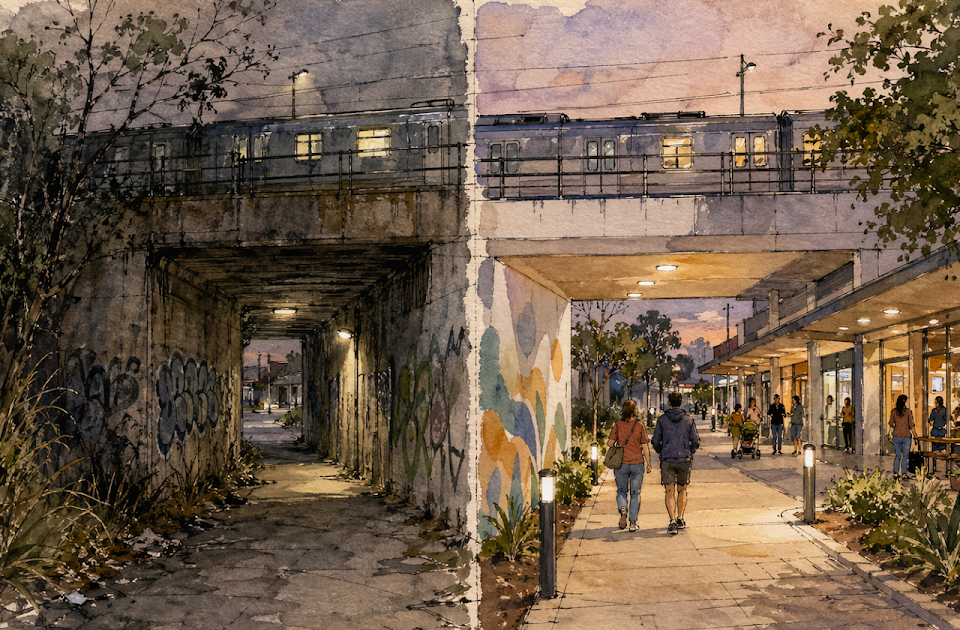
That is the wrong starting point. Public safety is not just a policing question and it is not just a sentencing question. It is also a maintenance question. A lighting question. A sightline question. A transport-staffing question. A clean-up-the-graffiti-fast question. A stop-leaving-public-space-to-rot question.
None of that sounds heroic, which is probably why it gets less attention. But a place that is dim, neglected, confusing, poorly watched, and badly managed can feel unsafe even before a politician turns up to describe it on television. Public safety often begins with whether the basics are being done properly by someone, every week, on a budget.
The boring safety stuff is the stuff that works
- Core claim: Public safety usually depends more than people admit on ordinary upkeep, design, visibility, and staffing.
- What people get wrong: They treat crime prevention as a single big crackdown instead of a steady package of smaller controls.
- Why it matters: Places that are poorly maintained tend to feel less safe, function less well, and become easier to neglect politically.
- Who this affects: Train users, shift workers, students, older residents, parents, local traders, and anyone moving through public space after dark.
- Bottom-line reality check: A safer place is often a better-managed place before it is a tougher-sounding place.
The boring safety stuff is the stuff that works
The common safety script is emotional and tidy. Crime is rising, people are scared, therefore the answer must be more forceful punishment and more dramatic rhetoric. That script survives because it flatters the audience. It suggests danger is mostly caused by bad people, and mostly solved by sounding angrier about them.
Reality is usually more annoying. A badly lit station approach is a safety problem. A dead corner outside a row of shuttered shops is a safety problem. A bus interchange with no clear visibility and no obvious help point is a safety problem. Graffiti left to spread, broken fittings left broken, overgrown landscaping, blind spots, inactive frontages, and public spaces that nobody seems responsible for are all part of the safety story.
The myths that make the debate dumber
- Public safety is mainly about punishment.
- Cleanliness, lighting, and design are cosmetic.
- If a place feels unsafe, only police or courts can fix it.
What the practical version looks like instead
- Safety is often cumulative. Small failures stack up.
- People judge risk through signals as much as statistics.
- Good management can reduce both actual opportunity for crime and the fear that nobody is in charge.
That last part matters more than people think. If a train platform is well lit, clearly visible, regularly cleaned, easy to navigate, and supported by active staff presence or help systems, it sends one message. If it is patchy, neglected, and visually abandoned, it sends another. The environment is already talking before any crime speech begins.
Why slogan-heavy crime politics keeps missing the point
None of this means crime is imaginary. It is not. ABS says about 395,100 Australians experienced physical assault in 2024–25, and 463,400 experienced face-to-face threatened assault. Households still experienced break-ins, property damage, and theft. The need for public safety is not a lifestyle preference. It is real. :contentReference[oaicite:1]{index=1}
But this is where the national conversation gets lazy. Real victimisation statistics do not automatically prove that every problem is best understood through punishment-first politics. A country can have genuine crime problems and still talk about them badly. That is exactly what happens when every safety debate turns into a contest over who can sound more alarmed.
Three things the slogan version keeps skipping
- Design still matters: NSW planning guidance keeps spelling this out through CPTED principles, maximise passive surveillance, avoid dark or concealed corners, and use lighting to connect spaces rather than leaving people moving through gaps.
- Maintenance still matters: Crime prevention measures work better as part of a package, not as gadgets dropped into neglected places.
- Youth panic is not the whole picture: AIHW says the number of young people under supervision on an average day fell by 18% over five years to 2023–24, which should make at least some people less confident about sweeping national panic stories.
That does not mean every resident who feels unsafe is overreacting. It means fear and policy are not the same thing. A station, street, or car park can absolutely need stronger enforcement in some situations. But if the surrounding conditions are still rubbish, the place keeps advertising weakness.
This is why the “safety versus amenity” framing is so silly. Lighting is amenity and safety. Clear pedestrian lines are amenity and safety. Active shopfronts are amenity and safety. Fast repair and graffiti removal are amenity and safety. A ranger, attendant, or visible staff presence is not decorative. It tells people the space has a pulse and a chain of responsibility.
What a grown-up safety agenda would look like
A grown-up safety agenda would sound less cinematic and more municipal. It would ask who maintains the lights, who clears the sightlines, who fixes the busted gate, who keeps transport interchanges legible after dark, who removes graffiti quickly, who follows up when a trouble spot starts repeating, and who notices when public space is quietly deteriorating.
That is not a small vision. It is a serious one. Public safety gets undermined when governments and councils leave places in that half-dead condition where nothing is totally broken, but everything feels slightly abandoned. That is where trust drops. That is where ordinary users start changing their routes, their habits, and their sense of belonging.
What a less fake safety conversation would include
- Lighting that closes the dark gaps: Not just one bright pole and three shadowy dead zones.
- Passive surveillance and active edges: Buildings, footpaths, entrances, and public areas designed so people can see and be seen.
- Routine maintenance as prevention: Broken things fixed early, graffiti removed quickly, overgrowth cut back, sightlines protected.
- Visible help and accountability: Staff, rangers, help points, or rapid response systems in the spaces people actually use.
- Targeted support, not only theatre: Especially where youth disengagement, repeated disorder, or place-based problems are already visible.
This is also where politicians hate the answer because it is expensive in a boring way. A crackdown can be announced in one press conference. Competent maintenance needs a budget every year. A slogan is cheaper than sustained staffing. A speech is cheaper than redesigning a station approach or keeping a public strip visibly cared for.
Public safety is not a vibe that governments can tweet into existence. It is the product of repeated choices. Budget choices. Design choices. Upkeep choices. Staffing choices. Enforcement choices too, yes, but not only those. A place feels safer when the public can see that somebody, somewhere, is consistently doing the dull work of making disorder harder and ordinary use easier.
FAQ
Q1. Is this saying policing does not matter?
A1. No. Policing matters, especially in places with repeated violence, intimidation, or serious offending. The point is that public safety is usually stronger when policing sits alongside lighting, maintenance, visibility, and competent place management.
Q2. Does better lighting and upkeep actually change anything?
A2. They can. Better lighting, clearer sightlines, maintenance, and visible surveillance reduce concealment, improve usability, and signal that a place is actively managed rather than abandoned.
Q3. Why focus on maintenance when crime victims need stronger action?
A3. Because the two are not opposites. Stronger action against offending can coexist with better everyday prevention, and the prevention side is often the part public debate neglects most.
References
- Australian Bureau of Statistics, “Crime victimisation, 2024–25 financial year” (2026). Official release. Supports the national assault, threat, break-in, and property crime context.
- Australian Institute of Health and Welfare, “Youth justice in Australia 2023–24” (2025). Official report. Supports the point that the number of young people under supervision on an average day fell over the last five years.
- NSW Planning, “Western Sydney Aerotropolis Development Control Plan amendment” (2025). Official planning document. Supports the role of passive surveillance, safe movement, lighting, and well-maintained public areas in safer public space design.
- Australian Institute of Criminology, “Considerations for establishing a public space CCTV network” (2011) and “Closed circuit television (CCTV): recent findings” (2005). Research paper. Supports the point that lighting, maintenance, graffiti removal, rangers, and other complementary measures matter alongside surveillance.