Can a Bite Mark Lie? Why Skin Distorts the Evidence : For Beginners de
Why a Bite Mark Can Mislead
A bite mark sounds like a tiny dental signature. Teeth leave a pattern. Investigators compare that pattern to a suspect’s teeth. The jury hears “match”, and the story feels settled.
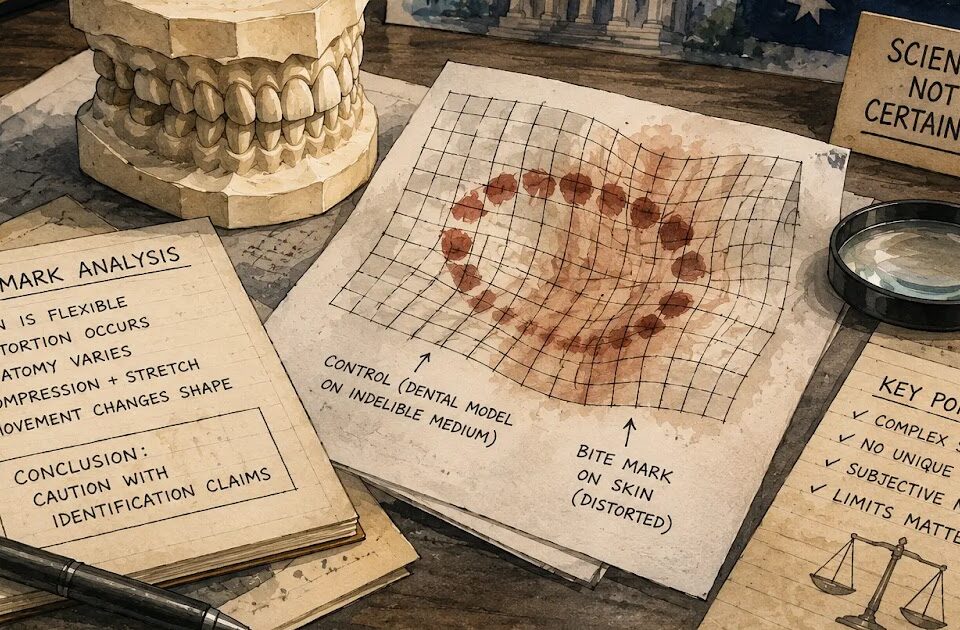
The problem is the surface. Human skin is not wax, plaster or a dental record. It stretches, bends, bruises, heals, swells and moves. That means a bite mark can carry information, but it can also distort it. The safer question is not “Do the teeth look similar?” It is “Can this mark reliably prove what the expert says it proves?”
How to Read Bite Mark Evidence Without the TV Goggles
- Why a bite mark can mislead
- The quick answer on bite mark evidence
- Why skin is a bad recording surface
- What Australian guidance gets right
- A practical checklist for readers
- When not to trust the bite mark story
- Final takeaway
- FAQs
- Disclaimer and references
The Quick Answer on Bite Mark Evidence
- Best for: Readers trying to understand criminal justice reporting, forensic science claims or courtroom evidence in plain English.
- What this covers: Why bite mark evidence is scientifically controversial, especially when used to identify a person from a mark on skin.
- What this does not cover: Legal advice, case strategy, dental treatment or an assessment of any specific Australian case.
- Main caution: A bite mark may sometimes help include, exclude or guide an investigation, but it should not be treated as a personal ID card.
- When to get professional help: If a real case involves bite mark evidence, speak with a qualified criminal lawyer and, where appropriate, an independent forensic odontologist.
The phrase “bite mark evidence” covers more than one claim. A careful expert might say a mark is possible or probable biting, or that a person cannot be excluded. A much stronger claim would be that a particular person made the mark. That stronger claim is where the science becomes highly contested.
Why Skin Is a Bad Recording Surface
A dental impression in a controlled material can preserve shape better than skin. Human skin is alive, elastic and uneven. It is stretched over muscles and bones. It can move during the incident and continue changing afterwards.
That matters because bite mark comparison depends on shape. If the shape changes, the comparison changes. A tooth can press, drag, rotate or leave only a partial mark. The person bitten may move. The biter may move. The angle can shift. Lighting and photography can add more distortion. By the time an expert sees an image, the mark may already be a poor copy of a poor copy.
The “soft surface” problem
Think of pressing a ring into firm clay, then pressing the same ring into a water balloon. The clay may hold a recognisable outline. The balloon will stretch, curve and bounce back. Skin is not exactly a water balloon, but the principle is close enough for a reader’s mental model: the surface does not behave like a flat sheet of paper.
That is why a bite mark can look meaningful without being reliable enough to identify someone. It might show a curved injury pattern. It might suggest teeth were involved. It might help exclude someone whose teeth clearly do not fit. But jumping from “similar” to “this person did it” is a much bigger claim.
A simple comparison table
| Claim about the mark | What it may support | Why caution is needed |
|---|---|---|
| “This could be a bite mark” | A possible explanation for the injury pattern | Other injuries can mimic patterns, and image quality matters |
| “The mark is not consistent with this person’s teeth” | Possible exclusion | Exclusion can be useful, but it still depends on mark quality |
| “This person cannot be excluded” | A limited association | It does not prove that person was the biter |
| “This person made the bite” | Individual identification | This is the most controversial claim, especially on skin |
What Australian Guidance Gets Right
Australian guidance on bitemark analysis has a noticeably cautious tone. The Australian Society of Forensic Odontology’s 2013 guidelines say it is now rare for odontologists to be asked to identify suspects on the basis of a bitemark, partly because DNA analysis and other biological tools provide more accurate ways to prove identity or association.
The same guidance warns against definitive identity language. It says conclusions of identity are rarely justified, that terms such as “identified”, “positive identity” and “match” are not endorsed as conclusionary statements for bitemark comparison reports, and that the term “unique” or similar individuality language should be avoided.
That caution is useful because it separates forensic odontology from forensic overclaiming. Dentists and forensic odontologists can have legitimate expertise. Dental identification of deceased people, for example, is a different and often much stronger use of dental evidence. The problem is not dentistry. The problem is asking a distorted skin mark to do the work of a fingerprint or a clean DNA profile.
Australia-specific reader note
Australia does not have one single criminal courtroom. Evidence rules and procedures can vary across states, territories and federal matters. A court may still decide that some expert evidence is admissible in a specific context. But admissible does not always mean conclusive. It means the court has allowed it to be heard under the relevant legal test.
For readers, that distinction matters. A headline saying “bite mark evidence used in court” does not mean the evidence proved identity beyond dispute. It may mean the evidence was allowed for a narrower purpose, such as describing a possible injury mechanism, excluding a person or supporting a limited comparison.
The Scientific Criticism Is Not Just Internet Scepticism
Major scientific reviews have raised serious concerns about bite mark analysis. NIST’s review work has highlighted three unsupported premises: that front-tooth patterns have been shown to be unique at the individual level, that those patterns are consistently transferred accurately to skin, and that examiners can accurately analyse the injury pattern to exclude or not exclude people.
PCAST, a US presidential science advisory council, reached an especially blunt conclusion in 2016: bite mark analysis did not meet scientific standards for foundational validity. It also noted that available evidence suggested examiners could not consistently agree on whether an injury was a human bite mark, let alone identify the source with reasonable accuracy.
That does not settle every legal question in Australia. But it does give readers a strong scientific warning: be careful whenever a subjective pattern comparison is presented as if it were a clean measurement.
The legal tradeoff
Courts often face hard choices. Excluding a forensic technique completely may worry investigators and prosecutors if the evidence could help in rare cases. Allowing it too freely may increase the risk that a jury hears more certainty than the method deserves.
The middle path is not glamorous, but it is safer: strict limits, cautious language, clear error discussion, independent review and no identity claim unless the method can actually support it.
A Practical Checklist for Readers
Use this checklist when a documentary, news report, podcast or court story mentions bite mark evidence.
- Ask what the expert actually claimed. Did they say “possible bite”, “probable bite”, “cannot exclude”, “consistent with” or “identified”?
- Separate injury classification from suspect identification. Deciding whether something is a bite mark is not the same as deciding who made it.
- Look for skin distortion. Was the mark curved, swollen, partial, photographed late or located on a body area that moves?
- Check whether DNA or other biological evidence exists. If stronger evidence is available, ask why the case depends on the bite mark.
- Watch for the word “match”. In bite mark cases, that word can be more dramatic than scientific.
- Ask whether the expert discussed limits. Good forensic evidence should come with boundaries, not just confidence.
- Notice whether the case relies on one fragile clue. A weak mark becomes more dangerous when it carries the whole story.
Red flags in bite mark reporting
- The article says “matched the suspect” but gives no detail about method or uncertainty.
- The story treats skin like a perfect mould.
- The expert uses identity language without explaining distortion.
- No alternative explanation is discussed.
- The bite mark evidence is presented as stronger than DNA without a clear reason.
- The reporting focuses on shock value rather than the quality of the evidence.
Mini Scenario: The Bad Photo Problem
Imagine police receive one blurry photo of a suspected bite mark on an arm. The photo was taken hours later, under uneven lighting, without a scale in the image. The skin has swollen. The person moved during the incident. The mark shows a curved pattern, but only part of the pattern is visible.
An expert may still be able to say something cautious, such as “this could be consistent with biting” or “there are insufficient features for meaningful comparison”. What they should not do is turn that weak image into a confident personal identification.
That is the core problem. Bite mark evidence can be useful at the low-confidence end and dangerous at the high-confidence end.
When Not to Trust the Bite Mark Story
Do not trust a bite mark story when it behaves like a magic trick. If the mark starts as a vague injury and ends as a confident accusation, the reader should slow down.
Also be careful when the story leans on authority alone. “A forensic dentist said so” is not enough. The better questions are: What was the method? Was the mark clear? Was distortion considered? Was the conclusion limited? Was there independent review? Was there stronger evidence?
What a safer conclusion sounds like
A safer conclusion does not pretend the mark is useless. It sounds more like this:
“The mark has features that may be consistent with biting, but the quality and distortion of the injury limit any comparison. The suspect cannot be excluded on this evidence alone, but the finding should be considered only in the context of other evidence.”
That sentence is less exciting than “the bite mark matched”. It is also much more honest.
Final Takeaway
A bite mark can tell part of a story, but skin is a poor witness. It stretches, heals, distorts and refuses to preserve teeth like a neat dental mould.
Forensic odontology still has important roles, especially in dental identification and careful injury assessment. Bite mark comparison on skin is different. The responsible position is not to panic or sneer at every expert. It is to demand that the conclusion stay inside the limits of the evidence.
If the mark is distorted, the language should be modest. If the evidence is uncertain, the jury should hear that uncertainty clearly.
FAQs
Q1. Is bite mark evidence banned in Australia?
A1. This article does not make a blanket legal claim. Australian courts assess expert evidence under applicable legal rules and case context. The safer point is that bite mark evidence should be treated cautiously, especially when it claims to identify a person from skin.
Q2. Can bite marks ever be useful?
A2. Sometimes, yes. They may help describe an injury, support a limited comparison or exclude a person in some circumstances. The problem is when a limited comparison is presented as a definitive personal identification.
Q3. Why is skin distortion such a big issue?
A3. Bite mark comparison depends on the shape of the mark. Skin stretches, moves, swells and heals, so the shape left on skin may not accurately preserve the teeth that made it.
Q4. Is forensic odontology the same as bite mark comparison?
A4. No. Forensic odontology includes dental identification and other dental evidence work. Bite mark comparison on skin is one controversial part of the field, not the whole field.
Q5. What should a reader ask when a report says “bite mark match”?
A5. Ask what “match” means, whether the mark was clear, whether distortion was considered, whether the expert used cautious language and whether stronger evidence supports the claim.
By: Raxan.net Editorial Team
About the author: Raxan.net publishes practical explainers on science, technology, public-interest topics and media literacy. This article is educational and is not legal advice.
Last updated: 2026-06-23
Disclosure: No sponsor or affiliate relationship influenced this article.
Disclaimer
This article is for general educational and media-literacy purposes only. It is not legal advice, forensic consulting, dental advice or an assessment of any specific case. If a real matter involves bite mark evidence, speak with a qualified legal professional and, where appropriate, an independent forensic expert.
References
- NIST, “Forensic Bitemark Analysis Not Supported by Sufficient Data, NIST Draft Review Finds,” 2022: https://www.nist.gov/news-events/news/2022/10/forensic-bitemark-analysis-not-supported-sufficient-data-nist-draft-review
- Australian Society of Forensic Odontology Inc., “Guidelines for the conduct of Bitemark Analysis in Australia,” 2013: https://www.ausfo.org.au/wp-content/uploads/Bitemark_Guidelines_V1.0_Oct_2013.pdf
- PCAST, “Forensic Science in Criminal Courts: Ensuring Scientific Validity of Feature-Comparison Methods,” 2016: https://obamawhitehouse.archives.gov/sites/default/files/microsites/ostp/PCAST/pcast_forensic_science_report_final.pdf
- National Academies, “Strengthening Forensic Science in the United States: A Path Forward,” 2009: https://www.nationalacademies.org/projects/STLP-Q-06-03-A/publication/12589
- AP News, “Louisiana death row conviction overturned as man’s lawyers cite faulty forensic analysis,” 2025: https://apnews.com/article/death-row-louisiana-jimmie-duncan-michael-west-0a2c95d4b95d02d8eff7d02c88ee175f