Government Email Scams Australia: Why We Don’t Click : For Beginners de
The Email That Wants You Calm and Suspicious at the Same Time
Remember when banks and government agencies told us, very firmly, not to trust unexpected emails? Don’t click links. Don’t open attachments. Don’t hand over personal details. Don’t panic. Don’t be fooled by logos. Don’t believe urgency.
Lovely advice.
Then official-looking messages started arriving with buttons, links, reminders, updates, cheerful wording, and just enough bureaucracy to smell authentic. Australians are now expected to be calm, alert, suspicious, digitally literate, emotionally balanced, and apparently available for unpaid phishing forensics before breakfast.
That is the comedy of government email scams in Australia. The message may be real. The warning may be important. The delivery can still feel like a scam wearing a visitor badge.
Government Email Scams Australia: Inbox Reality Check
- The Email That Wants You Calm and Suspicious at the Same Time
- The Complaint, Before Someone Prints a Policy Manual
- How Australia Trained Us to Fear the Link
- Useful Alert or Public Service Jazz Hands?
- A Tiny Survival Guide for Official-Looking Messages
- What Government Emails Should Look Like Instead
- FAQ
- References
The Complaint, Before Someone Prints a Policy Manual
This is not an argument that every message from myGov, Medicare, Centrelink, Services Australia, or the ATO is fake. Agencies need to contact people. Payments change. Tax time arrives. Medicare cards expire. Accounts need security reminders. Life happens, usually with a login page waiting somewhere nearby.
The complaint is simpler: public agencies spent years teaching Australians that scam messages pretend to be official. Then official messages too often borrow the same inbox behaviours that make people nervous.
That is not ideal. That is like putting a fire safety poster on a box of matches and calling it public education.
Australian government sites already warn people about this exact problem. myGov says scammers pretend to be myGov to steal details or money. Services Australia warns about scams pretending to be from myGov, Medicare, Centrelink and Services Australia. The ATO warns people to verify suspicious messages claiming to be from the ATO. Scamwatch says scam emails can look like the real thing, including copied logos and similar-looking email addresses.
So yes, the public got the memo. The problem is that the memo arrived by email, with a button.
How Australia Trained Us to Fear the Link
The modern Australian inbox is a little obstacle course with Wi-Fi.
One message says your parcel is stuck. Another says your Medicare card has expired. Another says the ATO has a refund. Another says your bank needs “verification”, because apparently every scammer took the same online course called How to Sound Urgent and Vaguely Official.
Then a real government notice arrives.
Wonderful. Now the reader has to become a detective. Does the sender look right? Is the domain right? Is the tone too urgent? Is the logo slightly off? Is the button legitimate? Why is there a link? Why is there always a link? Did democracy outsource common sense to a blue rectangle that says “View message”?
It is exhausting.
The people most likely to be targeted are often the people who least deserve another digital chore: older Australians, carers, people managing Centrelink payments, families dealing with health admin, small business owners facing tax deadlines, and anyone who already has three browser tabs open titled “what does this mean?”
Mini case: Nan versus the button
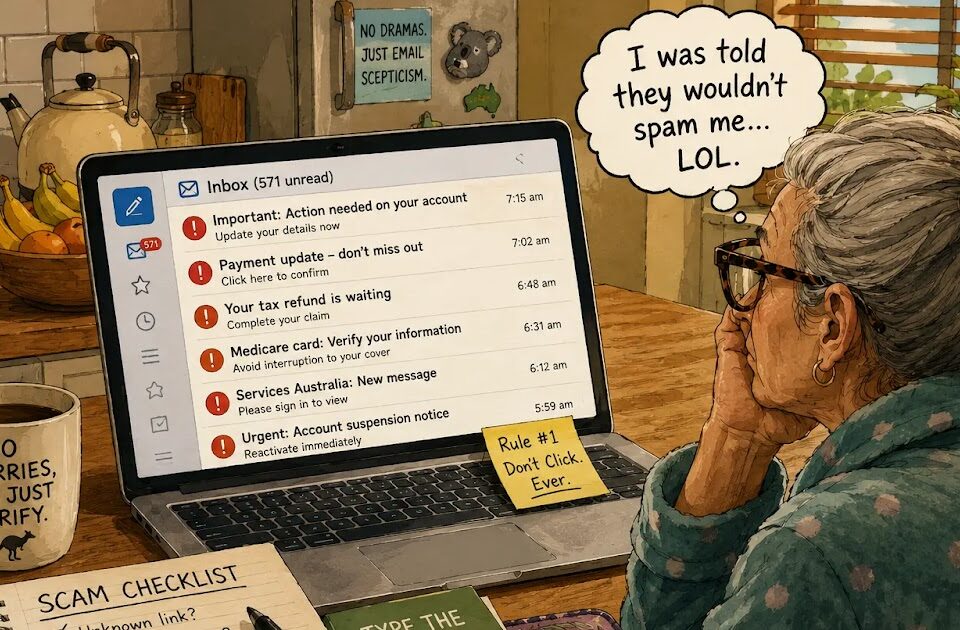
Imagine Nan gets an email saying there is an account issue.
It has a logo. It has official language. It has a button. It is probably important. It is possibly fake. It may even be both useful and badly designed, just to keep the blood pressure interesting.
She does what every safety page tells her to do. She does not click. She opens a browser, types the official website herself, signs in properly, checks her account, and finds out whether anything needs attention.
Excellent. She wins.
Also, why did basic public communication require a tactical operation?
Useful Alert or Public Service Jazz Hands?
There is a difference between a clean alert and inbox theatre.
| Message style | What it feels like | What the reader needs | Risk |
|---|---|---|---|
| Plain official alert | Boring but useful | What changed, who is affected, where to verify | Low confusion |
| Marketing-style update | A newsletter with a badge | The actual point, minus the confetti | Medium confusion |
| Urgent link-heavy message | Scam cosplay, possibly accidental | Independent verification | High confusion |
| Real scam | Trouble in a trench coat | Report, delete, block | Very high risk |
The ideal official email should be so plain it could put a possum to sleep. That is not an insult. That is the feature.
A government message does not need to inspire, delight, engage, activate, or take the reader on a journey. It needs to say: here is the issue, here is what not to do, here is where to check it safely. Then it should leave quietly, like a responsible adult.
Where sarcasm has to be fair
There is a tradeoff.
If agencies never email, people miss deadlines and updates. If agencies email too casually, people ignore them. If agencies email too dramatically, they start sounding like a scammer who bought a blazer.
The solution is not silence. It is discipline. Government emails should not compete for attention like EOFY mattress sales. They should reduce panic, not audition for Best Supporting Role in an Inbox.
A Tiny Survival Guide for Official-Looking Messages
Use the message as a hint, not as the doorway.
If an email says something is wrong with myGov, go to my.gov.au yourself. If it mentions Medicare, Centrelink, or Services Australia, type servicesaustralia.gov.au yourself. If it claims to be from the ATO, type ato.gov.au yourself. If you are unsure, check Scamwatch or the agency’s scam page.
Do not let a button boss you around. Buttons are not managers.
Quick checklist
- Do not click unexpected links or buttons in messages about money, tax, benefits, Medicare, or identity.
- Do not open attachments unless you were expecting them and can verify the sender.
- Do not give your myGov sign-in details, passwords, bank details, or codes through an email link.
- Do not rush because a message sounds urgent. Urgency is a scammer’s cologne.
- Do type the official website into your browser or use the official app you already installed.
- Do help older relatives verify messages without making them feel silly for asking.
What Government Emails Should Look Like Instead
Here is the radical, almost shocking idea: make them boring.
Subject line: “Action may be needed on your account.”
Body: “We will never ask for your password, bank details, or sign-in code by email. Do not click links in unexpected messages. To check this notice, go to the official website by typing the address into your browser.”
Then give the official website name in plain text.
That’s it. No fireworks. No leadership quote. No “exciting update”. No “we’re committed to enhancing your digital journey”, which is corporate for “we hired three consultants and a thesaurus”.
Government communication should not sound like it is trying to win engagement metrics. It should sound like someone soberly labelled a folder.
The Bottom Line: Boring Is a Security Feature
Australians do not need official emails to be charming. We need them to be clear enough that our parents do not ring us asking whether Medicare has been kidnapped.
Government agencies and banks asked the public to become suspicious of unexpected links. Fair enough. But once you train everyone to distrust the inbox, you cannot act surprised when people look at every official-looking message like it just climbed through a window.
The safest government email is not the prettiest. It is the one that gives the least room for confusion.
Less sparkle. Fewer buttons. More plain language.
And maybe, just maybe, stop making the real thing look like the thing you warned us about.
FAQ
Q1. Are emails from myGov, Services Australia, Medicare, Centrelink, or the ATO always scams?
No. These agencies may send legitimate notices. The safer habit is to treat unexpected messages as alerts only, then verify by going directly to the official website or app.
Q2. What should I do if a government-looking email includes a link or button?
Avoid clicking it if you were not expecting it. Type the official website into your browser, use the official app, or check the agency’s scam-warning page.
Q3. Why is this a bigger issue for older Australians and carers?
They may manage more health, benefit, pension, or family admin, and scammers often imitate exactly those services. The fix should not be “everyone become a cyber analyst”. The fix should be clearer communication.
By: Rex Iriarte
Why trust this: Editorial commentary on consumer technology, public communication, and inbox trust, checked against Australian government scam-warning pages from myGov, Services Australia, the ATO, and Scamwatch.
Last updated: 3 July 2026
Disclosure: No paid placement influenced this post.
Disclaimer
This is opinion commentary for general information and digital-safety awareness. It is not legal, tax, financial, or government-benefit advice. For personal account, tax, or benefit questions, use official Australian government websites or contact the relevant agency directly.
References