Huntsman Spider Survival Guide for Plastic Container Panic : For Beginners de
The Moment You Realise the Wall Has Legs
There is a special Australian household silence that happens when someone spots a huntsman spider. Nobody breathes. Nobody blinks. One person whispers, “Get a container,” as if the spider has already heard the plan and is now reviewing its legal options.
The recent buzz around an Australian brown huntsman being reported as possibly the fastest spider recorded has not helped the mood. A spider that already looked like it had errands now comes with speed statistics.
This huntsman spider guide is for the person standing in the hallway with a plastic container, a piece of cardboard, and the confidence level of a damp biscuit. The goal is simple: understand what you are dealing with, avoid chaos, and relocate the eight-legged houseguest without turning the lounge room into a crime scene.
What This Huntsman Panic Guide Covers
- The Moment You Realise the Wall Has Legs
- Huntsman Spider Quick Answer for Australians
- Why Huntsman Spiders Look Like They Pay Rent
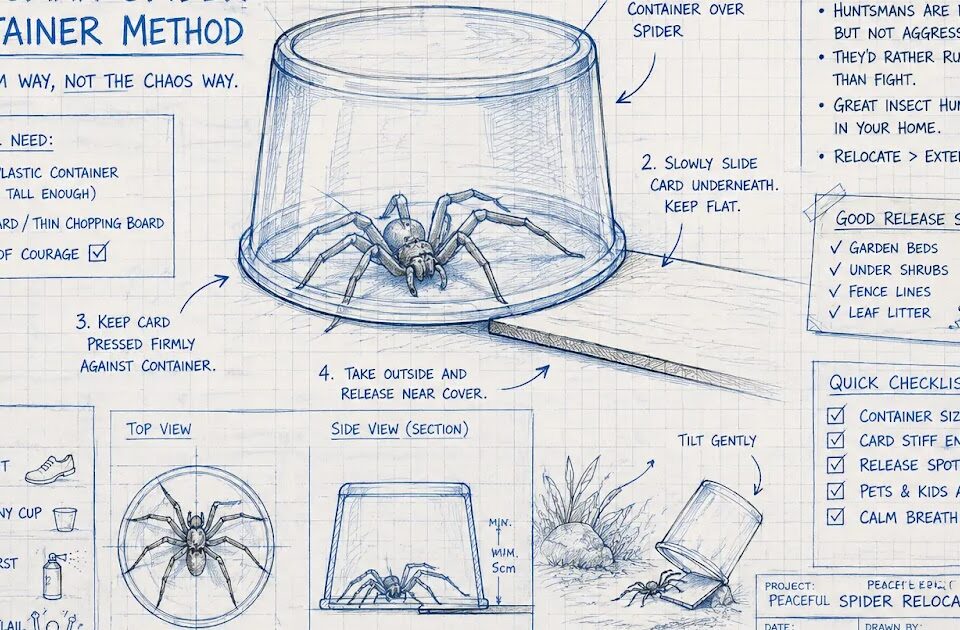
- The Plastic Container Method, Without the Drama
- Mistakes That Turn One Spider Into a Whole Incident
- Final Verdict: Brave Enough, Not Silly Enough
- Your Calm-Down Checklist
- FAQs About Huntsman Spiders in Australian Homes
- References
Huntsman Spider Quick Answer for Australians
- Best for: Australians who found a huntsman indoors and are trying not to move house.
- Main takeaway: Huntsman spiders are fast and alarming, but they are usually not aggressive and are often better relocated than attacked.
- Time, cost, or effort: About 2 to 5 minutes, one clear plastic container, one stiff card, and one person pretending to be calmer than they are.
- Best result to expect: Spider outside, household dignity mostly intact, no unnecessary harm.
- When not to use this: Do not try the container method if the spider is in a risky spot, if someone may fall, if you cannot identify the spider, or if anyone has been bitten and symptoms are worrying.
Why Huntsman Spiders Look Like They Pay Rent
Huntsman spiders are large, long-legged spiders often seen in Australian homes, sheds, cars, and other places where they have no appointment. Their flattened bodies help some species squeeze into tight spaces, which explains why one can seem to appear from behind a picture frame like it has been waiting for the third act.
The Australian Museum notes that huntsman spiders are not considered dangerous spiders, even though they do have venom and a bite can cause some ill effects. They are also reluctant to bite and usually try to run rather than fight.
That last sentence is meant to be comforting. It may not feel comforting when the spider runs directly toward the skirting board at a speed that suggests it has a meeting.
The speed problem, also known as “absolutely not”
A 2026 report described the Australian brown huntsman, Heteropoda jugulans, as potentially the fastest spider recorded, with a peak speed reported at 3.59 metres per second. That does not mean the huntsman in your laundry is training for the Olympics. It does mean your nervous system is not being dramatic when it says, “That thing moved.”
For normal household purposes, the important lesson is not “panic faster.” It is “prepare before you approach.” Have the container and card ready. Clear the area. Decide where you will release it. Then move steadily.
The awkward truth: it may be helping
Here is the betrayal: the spider you want gone may be doing useful work. Huntsman spiders eat insects and other small prey around homes and gardens. That does not mean you must let one sleep above your bed like a furry smoke alarm. It does mean the best response is usually relocation, not household warfare.
The Plastic Container Method, Without the Drama
The container method works because it gives you distance, visibility, and a controlled way to move the spider. It also gives everyone else in the room something to shout about.
Use a clear plastic container if possible. A round takeaway tub, storage container, or large jar can work, as long as it is wide enough to cover the spider without catching its legs. Use stiff cardboard, a thin chopping mat, or a firm envelope as the sliding barrier.
The calm-ish step-by-step method
- Clear the runway. Move pets, small children, and unnecessary spectators away. Spectators will not help. They will only provide live commentary.
- Choose your release point first. A garden edge, fence line, or sheltered outdoor spot is better than making decisions while holding a container full of adrenaline.
- Approach slowly. Fast movements can startle the spider. They can also startle you into inventing new dance moves.
- Place the container over the spider. Aim to cover it fully in one smooth motion. Do not slam it.
- Slide the card underneath. Keep the container flat against the surface while easing the card in.
- Keep the card sealed. Hold the card firmly against the container opening.
- Walk outside like a person with a plan. Not too fast. Not too heroic.
- Release near cover. Tilt the container away from your body and let the spider leave in its own dramatic fashion.
Quick decision guide
- If the spider is on a flat wall or floor, use the container and card method.
- If it is high on the ceiling, use a broom only if you can do it safely and gently, or wait for it to move lower.
- If it is inside a car while driving, pull over safely before doing anything. The spider is not the emergency. Losing control of the car is.
- If it is near an egg sac, give it more distance and consider professional help if it is indoors and difficult to move.
- Skip the DIY approach if the spider is in a dangerous location, if someone could fall, or if you are too panicked to act safely.
Mistakes That Turn One Spider Into a Whole Incident
The spider is not the only unpredictable object in the room. Humans under spider pressure make strange choices. They climb furniture. They throw shoes. They outsource the problem to the least qualified sibling. None of this improves the situation.
A huntsman usually wants to get away. Your job is to avoid making the room feel like a collapsing obstacle course.
Common mistakes
- Using a tiny cup: This is how you end up measuring regret. Use a container with enough room for the spider’s leg span.
- Trying to trap it with soft paper: Floppy paper bends at the worst possible moment. Use firm card.
- Screaming instructions at the rescuer: The person holding the container is already living through cinema. Give clear, short help or step back.
- Spraying first and thinking later: Sprays can create chemical mess, distress pets, and may not solve the entry problem.
- Trying to squash it: Apart from being unnecessary in most cases, this can stain surfaces, escalate panic, and remove a useful pest hunter.
- Balancing on chairs: A fall is more likely to hurt you than the spider is.
Safer alternatives compared
| Option | Best for | Pros | Cons |
|---|---|---|---|
| Clear container and card | Spider on wall, floor, or window | Cheap, visible, controlled, humane | Requires getting close |
| Soft broom guidance | Spider near a doorway or low wall | Keeps more distance | Less precise, spider may run |
| Leave it alone | Garage, garden, shed, or low-traffic area | No stress, spider keeps hunting insects | Not ideal near beds, towels, or shoes |
| Professional pest advice | Repeated indoor spider issues or hard-to-reach areas | Safer for tricky situations | Costs money and may not be needed for one spider |
The Mini Scenario: Midnight Bathroom Treaty
It is 11:42 pm. You walk into the bathroom and see a huntsman above the towel rail. The spider is large enough to appear financially independent. You have three choices.
Choice one: scream and wake the whole house. This creates community, but not progress.
Choice two: throw a thong. This may feel traditional, but it is inaccurate, messy, and likely to make the spider move in a direction nobody voted for.
Choice three: get a container, slide a firm card underneath, and release it outside. This option takes about three minutes and gives you a story without needing repairs.
The third option wins unless the spider is too high to reach safely. In that case, close the bathroom door, block the gap with a towel if needed, and wait until it moves lower or ask someone steady to help. Courage is good. Climbing half-asleep onto wet bathroom tiles is not courage. It is paperwork.
When Not to Be a Hero
Most huntsman encounters are more embarrassing than dangerous, but there are moments when caution matters. If someone is bitten and has severe pain, spreading symptoms, breathing difficulty, faintness, or any reaction that worries you, seek medical advice promptly. For suspected serious spider bites in Australia, follow official first-aid guidance and call emergency services when appropriate.
Also, do not attempt a close capture if you cannot clearly see the spider. Australia has many spider species, and not every spider in a dark corner deserves the same casual treatment. Good lighting is not cowardice. It is quality control.
If the spider is in a child’s room, a car, a tight appliance space, or somewhere that could cause a fall, slow down. The bravest person in the room is sometimes the one who says, “Let’s not make this worse.”
Final Verdict: Brave Enough, Not Silly Enough
A huntsman spider in the house can feel like nature has breached the lease agreement. Still, most indoor encounters do not need panic, poison, or a dramatic retelling involving three adults and a laundry basket.
Use the clear container method when it is safe. Leave outdoor spiders alone when possible. Remember that huntsmen are fast because they are built to run, not because they have chosen you personally as an enemy.
The best Australian spider strategy is simple: respect it, relocate it, and try not to become the funniest part of the story.
Your Calm-Down Checklist
- Find a clear container wider than the spider’s leg span.
- Grab stiff cardboard before approaching.
- Move pets, kids, and loud commentators away.
- Choose the outdoor release spot first.
- Move slowly and avoid sudden swipes.
- Do not climb on unstable furniture.
- Seek medical advice if a bite causes worrying symptoms.
- Seal obvious entry gaps later, after your heart rate returns to normal.
FAQs About Huntsman Spiders in Australian Homes
Q1. Are huntsman spiders dangerous?
A1. Huntsman spiders are not generally considered dangerous, but they can bite and a bite may cause symptoms. Give them space, avoid handling them, and use cautious relocation rather than direct contact.
Q2. Why do huntsman spiders run so fast?
A2. Huntsman spiders are built for speed and pursuit. Recent reporting on brown huntsman research highlighted very high peak running speeds, which explains why indoor encounters feel so sudden.
Q3. Should I kill a huntsman spider in the house?
A3. In most cases, relocation is the better option. Huntsman spiders can help control insects, and moving one outdoors avoids mess, chemical use, and unnecessary harm.
Q4. What should I do if a huntsman is on the ceiling?
A4. Do not climb dangerously. Wait until it moves lower, gently guide it only if you can do so safely, or ask a steady adult or pest professional for help if the location is difficult.
Q5. Can I leave a huntsman alone?
A5. Yes, if it is in a garage, shed, garden, or low-traffic spot and nobody is at risk. If it is near a bed, towel, shoe rack, or car controls, relocation is more sensible.
By: Raxan Editorial Team
Why trust this: This article uses current Australian spider references, public health first-aid guidance, and practical household safety framing. It does not replace professional pest control, medical, or emergency advice.
Last updated: 2026-07-10
Disclosure: Independent editorial content. No sponsor or affiliate relationship is included.
Disclaimer
This article is general information for Australian readers and is not medical, pest-control, or emergency advice. If someone is bitten, symptoms are severe, or you are unsure what kind of spider is involved, use official first-aid guidance and contact a qualified professional or emergency service.
References