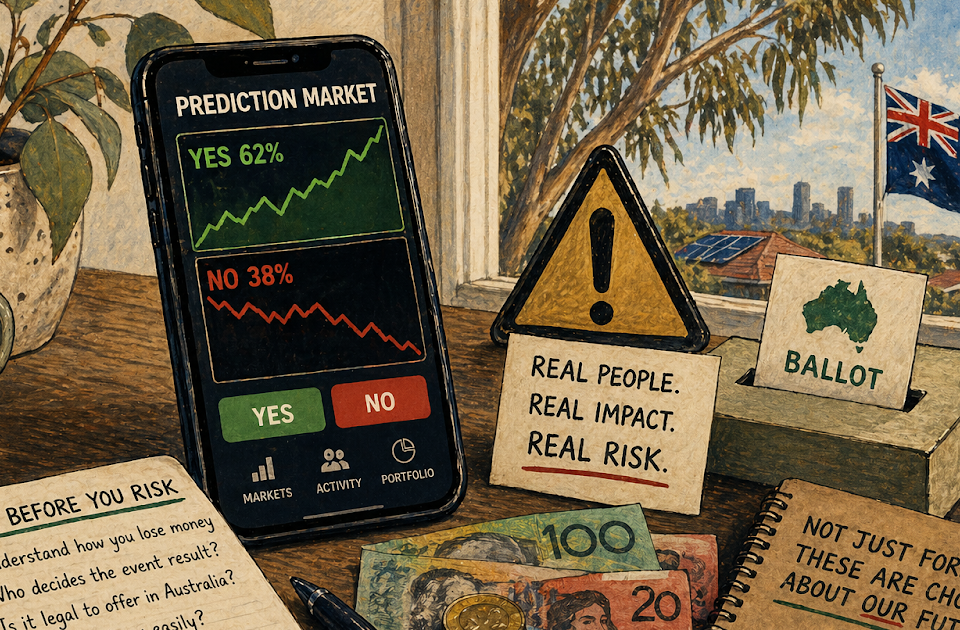
Prediction Markets: Betting Rebranded as Forecasting : For Beginners de
Why “not betting” is the line to question
Prediction markets are usually sold with clean words: forecasting, price discovery, event contracts, crowd wisdom. That language sounds smarter than gambling, which is exactly why it needs scrutiny.
At the consumer level, the basic action is simple. You risk money on whether a future event happens. If the event goes your way, you may receive a payout. If it does not, you can lose money. When the event is an election, war, public crisis or government decision, the issue is no longer just personal finance. It becomes a moral problem.
This Australian guide explains how prediction markets work, why the “not betting” claim can mislead, and what local warning cases show about scam-style product design.

A cautious Australian guide to prediction markets
- Why “not betting” is the line to question
- How prediction markets work without the spin
- The ethical problem with betting on public harm
- Three Australian warning cases that explain the pattern
- A practical scam-risk checklist
- Why Australian consumers should be extra careful
- What to do before putting A$1 into a forecast
- Questions Australians ask about prediction markets
- Educational disclaimer
- References
How prediction markets work without the spin
A prediction market lets people buy or sell positions tied to a future outcome. The question might be whether a candidate wins, whether a political event occurs, whether a conflict escalates, or whether a public decision is announced by a certain date.
The price may be presented as the crowd’s probability estimate. For example, if a contract price looks like a percentage, users may read it as “the market thinks this has a strong chance”. That can sound analytical. But for the ordinary person, the risk remains plain: money is being placed on an uncertain event.
The chart is not a crystal ball
A moving price does not prove the event will happen. It may reflect hype, rumour, low liquidity, social media attention, insider advantage, coordinated activity or a burst of emotional trading.
That matters because prediction-market interfaces can make uncertainty feel measurable and safe. A neat chart can make a gamble look like research.
“Event contract” can hide the betting-like experience
A product can avoid the word “bet” and still feel like betting. If the user risks money on a yes-or-no outcome, waits for an external result, and receives a payout only if the outcome lands the right way, the experience is betting-like even when the branding says otherwise.
The ethical question is not only, “Is this technically classified as gambling or a financial product?” The better question is, “Is this design encouraging people to profit from events that should not be treated as entertainment?”
The ethical problem with betting on public harm
Prediction markets become especially troubling when the event is not harmless. There is a moral difference between forecasting the weather for planning and wagering on elections, war, arrests, disasters or public unrest.
Elections are not a punt
Australia has compulsory voting, a strong public expectation around electoral integrity and a civic culture where elections are meant to belong to the public, not to a betting screen.
A market on an election can reward people for rumours, panic, misinformation or strategic noise if that noise moves the price. Even if most users are not trying to manipulate anything, the incentive is ugly. Democracy becomes a scoreboard.
War and crisis contracts create emotional distance
When a market lets people profit from conflict, violence or instability, the product can turn real harm into an abstract payout. Users may not see victims, families, communities or long-term consequences. They see a number moving.
That distance is the moral damage. The platform does not need to tell people to cheer for harm. It only needs to create a situation where harm may pay.
The “smart money” story can be unfair
Prediction markets often imply that the crowd knows something. Sometimes markets do gather information. But not every participant has equal information, equal tools or equal speed.
A casual Australian user may be on the other side of people with faster data, larger bankrolls, automated systems or closer access to the event. That is not a friendly public forecast. It can be an uneven contest with a friendly-looking interface.
Three Australian warning cases that explain the pattern
These cases do not prove that every event contract in every country is illegal or fraudulent. They do show why Australians should be cautious when a product says “not betting” while using betting-like mechanics.
Case 1: Binary options showed how yes-or-no products hurt retail clients
Binary options are not identical to all prediction markets, but they are a close warning sign because the structure is often simple: a yes-or-no result, a fixed payout if the user is right, and loss if the user is wrong.
ASIC banned the issue and distribution of binary options to retail clients and later extended that ban until 1 October 2031. ASIC said these products had resulted, and were likely to result, in significant detriment to retail clients.
What the public was sold: a simple market-style way to profit from an outcome.
What the regulator saw: a product causing serious retail-client harm.
The consumer lesson: simple does not mean safe. A yes-or-no payout can be easier to market than to understand.
Case 2: Illegal offshore gambling shows the danger of slick access
ACMA can investigate and take enforcement action where operators provide or advertise prohibited or unlicensed online gambling services in Australia. The regulator also responds to complaints about unlicensed services.
That matters because Australians can see polished overseas websites, social posts and app-like interfaces that appear legitimate simply because they are accessible. Accessibility is not approval. A website can load on a phone and still leave the user without the consumer protections that would exist in a lawful Australian setting.
What the public may see: a professional platform with modern design.
What the risk may be: offshore operation, unclear protections, difficult complaints and weak recourse.
The consumer lesson: if a service is outside Australian oversight, the user may be taking more than financial risk. They may be relying on a business they cannot realistically hold accountable.
Case 3: Self-exclusion protections show why gambling safeguards matter
Australia has BetStop, the National Self-Exclusion Register, which lets people exclude themselves from licensed Australian online and phone wagering services in one step. Once registered, licensed providers must not let the person place bets, open new betting accounts or receive gambling marketing.
This matters for prediction markets because the “not gambling” label can route people around the emotional safeguards they would normally apply to betting. A person who knows they have gambling-risk behaviour may avoid wagering apps, but still be pulled into prediction markets because the product calls itself forecasting.
What the public is told: this is a market, not a betting site.
What the behaviour may trigger: chasing losses, event obsession, late-night deposits, emotional decision-making and risk escalation.
The consumer lesson: if a product creates betting-like behaviour, the label should not be allowed to make the risk disappear.
A practical scam-risk checklist
Use this as a stop sign, not as a participation guide. The goal is to avoid being pulled into a product that uses professional language to soften gambling-like risk.
Red flags that deserve a hard no
- The platform avoids the word “bet” while asking for money on an uncertain event.
- The event involves elections, war, arrests, public violence, tragedy or government action.
- The product says “market signal” but does not clearly explain oversight, complaint rights, fees and withdrawal rules.
- The interface looks like trading, but the outcome works like a yes-or-no punt.
- The platform uses urgency, countdowns, influencers or referral rewards.
- You cannot easily tell who resolves the event if the outcome is disputed.
- Withdrawal rules are vague, slow or conditional.
- You feel tempted to deposit more because you want to “win back” a wrong forecast.
Quick comparison table
| Feature | Cautious regulated product | Scam-style prediction product |
|---|---|---|
| Main appeal | Risk transfer or structured market purpose | Excitement, being right, fast payout |
| Event type | Clear economic measure or regulated market exposure | Politics, war, scandal, crisis or viral news |
| Risk disclosure | Clear, prominent and specific | Hidden under clever language |
| Consumer protection | Identifiable regulator and complaint path | Offshore, vague or hard to verify |
| Emotional hook | Slow, boring, rule-heavy | Urgent, social, gamified |
| Ethical concern | Still needs scrutiny | High when harm becomes profitable |
Why Australian consumers should be extra careful
Australia already has a strong debate about gambling harm, advertising exposure and online wagering. Prediction markets can slip into that debate wearing a different costume.
They can look like finance to people who dislike gambling. They can look like politics to people who dislike finance. They can look like entertainment to people who do not realise the product is designed around real money and emotional outcomes.
AUD losses still feel small until they stack
A$10 here, A$25 there, A$50 after a breaking-news event. Small amounts can make the product feel harmless. But the habit is the problem. Fast yes-or-no products can train the user to keep checking, keep reacting and keep trying to recover losses.
A product does not need to take A$5,000 in one hit to be harmful. It can normalise repeated risk.
“Everyone is talking about it” is not due diligence
If a prediction market becomes popular on social media, that does not make it safe. It may only mean the product has found a powerful emotional trigger: politics, fear, outrage or the thrill of being first.
The louder the conversation, the more important it is to slow down.
Offshore disputes can be hard to solve
If a platform blocks withdrawals, changes rules or disputes the result of an event, the user may discover too late that practical enforcement is difficult. Screenshots, emails and terms can help with complaints, but they do not guarantee recovery.
This is why the safest decision is made before deposit, not after loss.
What to do before putting A$1 into a forecast
The safest choice for a casual reader is not to put money into prediction markets, especially where the outcome involves elections, war, public safety, tragedy or vulnerable people.
If a product still has your attention, use the plain-English test below.
The plain-English test
Before risking any money, ask:
- Can I explain exactly how I lose money?
- Can I identify the Australian regulator or lawful oversight pathway?
- Can I verify whether the product is allowed to be offered to Australians?
- Can I withdraw without depositing more or meeting unclear conditions?
- Do I understand who decides the event outcome?
- Would I still feel comfortable if the event involved real public harm?
- Am I acting calmly, or reacting to fear, politics, outrage or hype?
If any answer is unclear, step away.
When not to engage at all
Do not engage when the event involves minors, violence, war, public tragedy, elections, riots, arrests or personal harm. Do not engage when a platform tells you the product is “not betting” but still rewards you for being right about uncertain real-world outcomes.
Also avoid any service that pressures deposits, promotes recovery schemes, offers suspicious bonuses, blocks withdrawals or asks for unusual identity steps through unofficial channels.
Before you let a forecast become a punt
Prediction markets can sound intellectual. That is part of the danger. They wrap old betting instincts in new market language, then ask people to feel smart while taking risks they may not fully understand.
The scam-like nature appears when a product changes the vocabulary but not the behaviour. The user still risks money. The outcome is still uncertain. The platform still benefits from activity. And in the worst cases, the event may involve democracy, conflict or human suffering.
For Australian readers, the safest rule is simple: if the product has to convince you it is not betting, pause. If it turns elections, war or crisis into a payout opportunity, walk away. Some things should not become clickable just because the interface looks clever.
Questions Australians ask about prediction markets
Q1. Are all prediction markets scams?
A1. No. Some event-style markets may exist within regulatory frameworks in some places. The concern is that many products use betting-like mechanics while presenting themselves as neutral forecasting tools. Consumers should examine the structure, not the branding.
Q2. Why compare prediction markets to binary options?
A2. Binary options are not the same as every prediction market, but they show how yes-or-no payout products can harm retail users. ASIC’s ban is a warning that simple outcome-based products can create serious consumer detriment.
Q3. Is a prediction-market price better than a poll or expert view?
A3. Not automatically. A price may reflect opinion, but it can also reflect hype, thin trading, rumours, unequal information or manipulation risk. It should not be treated as truth.
Q4. What makes election or war markets unethical?
A4. They can reward people for outcomes that affect real lives, public trust and safety. Even when a user does not intend harm, the product can create incentives that turn serious events into entertainment.
Q5. Does this article recommend any prediction market?
A5. No. This article is precautionary education. It does not recommend, rank, link to, or explain how to participate in prediction markets.
By: Rex Iriarte
About the author: Contributor at Raxan.net focused on practical education about technology, digital business and consumer risk. This article uses public regulatory sources and documented examples. It does not promote prediction-market participation.
Last updated: 2026-04-24
Disclosure: No paid placement influenced this post.
Educational disclaimer
This article is general consumer education, not legal, financial, investment or gambling advice. Laws and regulatory positions can change, and rules may vary by product, platform, location and user status. If you believe you have lost money through fraud, cannot withdraw funds, or feel unable to stop gambling-like behaviour, consider contacting official consumer-protection, financial-counselling or gambling-support services in Australia.
References