Could Microreactors Cut Australia’s Power Costs? : For Beginners de
Why Antares Mark-0 Matters to Australia
Australia does not need another energy miracle with a glossy render and a billion-dollar invoice hiding behind it. But Antares Mark-0 reaching criticality does raise a useful question: if Australia’s grid is being asked to power homes, mines, EVs, industry and a growing wave of AI data centres, should microreactors stay in the “too hard” basket forever?
The answer is not “build them tomorrow”. Australia still has a legal wall around nuclear power, and cost matters more than vibes. The better question is sharper: could microreactors ever beat the real alternatives on price, reliability, timing and risk?
Quick Map Before the Reactor Joins the Group Chat
- Why Antares Mark-0 Matters to Australia
- The Data Centre Power Problem Is the Real Hook
- Could Microreactors Lower Power Costs?
- The Legal Wall Around Nuclear Power in Australia
- Where Microreactors Might Make Sense First
- The Invoice Test
- Bottom Line
- FAQs
- References
The Data Centre Power Problem Is the Real Hook
Antares Mark-0 did not solve Australia’s energy problem. It did something smaller but still important: it showed that a privately developed advanced reactor design could complete a zero-power criticality demonstration at Idaho National Laboratory. In plain English, the reactor physics worked in a controlled test. That is not commercial electricity. It is not a cheap power bill. It is the engine coughing to life in the shed, not the ute towing a caravan across the Nullarbor.
Australia should care because electricity demand is changing. AEMO says data centres already account for around 2% of Australia’s grid-supplied electricity use, mostly around Sydney and Melbourne. It projects data centre consumption could reach around 12 TWh by 2030 and around 34 TWh by 2050.
That is the search hook. Not “nuclear future”. Not “energy destiny”. The hook is: who pays when AI, cloud computing and industrial loads want clean, reliable power all day and all night?
Could Microreactors Lower Power Costs?
Maybe, but only in the boring way that matters: through a costed project that works.
Microreactors are pitched as factory-built, smaller and deployable. The dream is repeatable manufacturing, less on-site complexity and reliable power close to where it is needed. If that works, costs could fall over time. But the first units are rarely cheap. First-of-a-kind infrastructure usually arrives with a learning bill, and that bill does not politely disappear because the brochure has nice fonts.
Australia’s current cost benchmark is not friendly to nuclear hype. CSIRO’s 2024-25 GenCost release said renewables backed by storage and transmission remain the lowest-cost new-build option, while small modular reactors remain the highest-cost option in its modelling.
So the aggressive but fair framing is this: microreactors should not be sold as cheaper power until they prove it. Put them beside solar, wind, batteries, pumped hydro, gas backup, transmission upgrades and demand response. Then make them fight in daylight.
The Legal Wall Around Nuclear Power in Australia
Here is the awkward part, and it is a big one. Australia currently has Commonwealth prohibitions that stop licences or approvals for nuclear power plants, fuel fabrication plants, enrichment plants and reprocessing facilities. State and territory laws add more layers in several places.
That means Antares Mark-0 is not “coming to Australia” in any simple sense. Before a commercial microreactor could be part of Australia’s electricity mix, the legal framework would need major reform. Then would come regulation, safety systems, emergency planning, fuel supply, waste arrangements, financing and community approval.
In other words, this is not a Bunnings run. You cannot just put “microreactor, 1 unit” in the trolley next to cable ties and a sausage sizzle.
Where Microreactors Might Make Sense First
The strongest Australian use cases are not ordinary suburban rooftops. Rooftop solar already owns that conversation with the confidence of someone who brought receipts.
Microreactors would have to start where reliability is worth a premium:
| Use case | Why it might fit | Main problem |
|---|---|---|
| Remote mines | High power demand far from strong grids | Cost, licensing and transport |
| Defence sites | Need firm power for critical operations | Security and regulation |
| Data centres | 24/7 load with high reliability needs | Public acceptance and price |
| Remote communities | Diesel replacement potential | Scale, safety and governance |
| Heavy industry | Heat and power demand | Long approval timelines |
The strongest case is not “cheap electricity for everyone by Tuesday”. The strongest case is “less diesel, fewer outages and firm power where the grid is weak or demand is unusually constant”.
The Invoice Test
The AER’s 2026-27 Default Market Offer showed price falls for many standing offer customers in New South Wales and South East Queensland, a small increase for South Australian flat-rate residential customers, and reductions for small businesses across the DMO regions. Good news, yes. A permanent fix, not exactly.
Most Australians do not judge energy policy from a white paper. They judge it from the bill, the blackout, the air conditioner, the business fridge and whether the retailer’s “better offer” email feels like homework with fees attached.
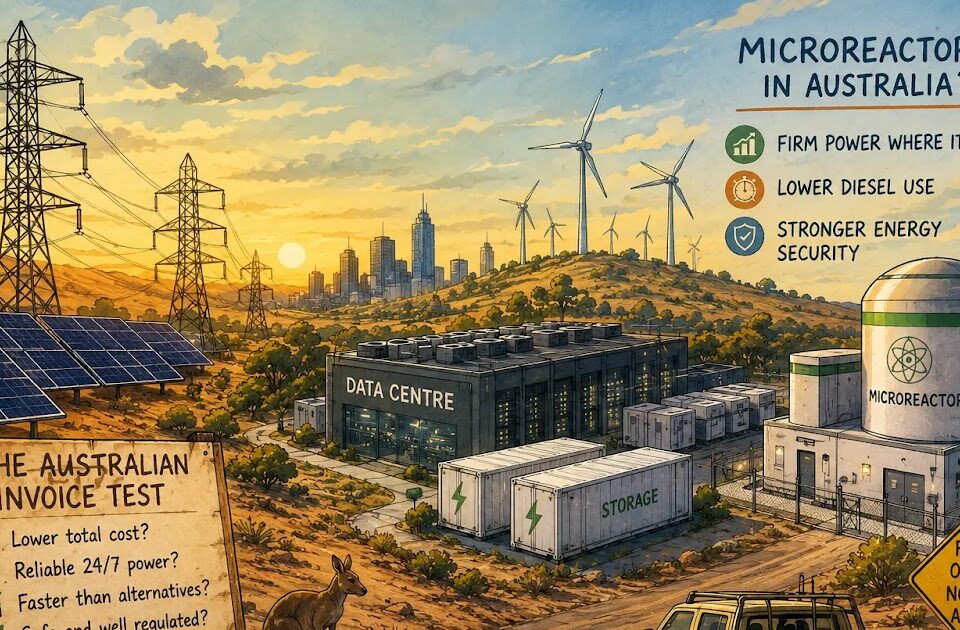
So here is the invoice test for any future microreactor proposal:
- What is the full cost per MWh after financing, insurance, fuel, waste, security and decommissioning?
- How many years from approval to actual electricity?
- What price does the customer pay, not the modelled price in a slide deck?
- What risk stays with the public if the project runs late?
- What cheaper option was rejected, and why?
If the answers are vague, the project is not ready. If the answers are clear and competitive, then it deserves a seat at the table.
Bottom Line
Antares Mark-0 is a real milestone, but Australia should treat it as a prompt for better questions, not a permission slip for nuclear daydreaming. Microreactors might eventually matter for data centres, mines, defence sites or remote loads. They might also remain too expensive, too slow or too hard to license.
That is fine. Technologies should earn their place.
Australia’s energy debate does not need more chest-beating. It needs arithmetic. If microreactors can beat the alternatives in specific use cases, show the numbers. If they cannot, they are not the future. They are expensive furniture with a control room.
FAQs
Q1. Did Antares Mark-0 start producing electricity?
No. It completed a zero-power criticality demonstration. That validates important reactor physics and operating assumptions, but it is not the same as commercial electricity generation.
Q2. Could microreactors cut Australian power bills?
Possibly in limited cases, but not automatically. They would need to prove lower total costs than renewables, storage, transmission, gas backup and demand management for a specific location or customer.
Q3. Are nuclear power plants legal in Australia right now?
No, not for commercial electricity generation under the current Commonwealth framework. Major legal and regulatory changes would be needed before microreactors could be deployed for Australian electricity supply.
By: Rex Iriarte
Why trust this: Editorial analysis based on public sources from DOE, AEMO, the Australian Parliament Library, AER and CSIRO, with a focus on energy costs, technology limits and Australian search intent.
Last updated: 2026-06-30
Disclosure: No sponsorship, affiliate payment or paid placement influenced this article.
Disclaimer
This article is editorial commentary for general information only. It is not engineering, legal, financial, investment or energy procurement advice. Any real energy project should be assessed by qualified professionals, regulators, affected communities and independent cost reviewers.
References
- U.S. Department of Energy, “Department of Energy Celebrates First Advanced Reactor Criticality,” 2026: https://www.energy.gov/articles/department-energy-celebrates-first-advanced-reactor-criticality
- AEMO, “Digital demand surge: Preparing Australia’s power systems for the rise of data centres,” 2026: https://www.aemo.com.au/newsroom/news-updates/digital-demand-surge
- Parliament of Australia, “Current prohibitions on nuclear activities in Australia,” 2024: https://www.aph.gov.au/About_Parliament/Parliamentary_departments/Parliamentary_Library/Research/Quick_Guides/2023-24/NuclearActivitiesProhibitions
- Australian Energy Regulator, “AER releases final Default Market Offer 2026-27,” 2026: https://www.aer.gov.au/news/articles/news-releases/aer-releases-final-default-market-offer-2026-27
- CSIRO, “CSIRO releases final 2024-25 GenCost report following consultation,” 2025: https://www.csiro.au/en/news/all/news/2025/july/2024-25-gencost-final-report