Six-Figure Salary in Australia: Rich or Just Broke? : For Beginners de
The six-figure salary myth has entered the group chat
A six-figure salary used to sound like victory music. You imagined financial peace, fancy olive oil, and maybe a washing machine that does not sound like it is training for the Olympics.
Then rent arrived. Then groceries. Then tax. Then electricity. Then one dental bill walked in wearing designer sunglasses.
A recent U.S. article described a new kind of “cash-poor” household: people earning decent money but still having very little left after the essentials. Australia should not laugh too loudly. We have our own version: the A$100k earner who looks comfortable on paper, then opens the banking app and whispers, “Surely this is a prank.”
The Six-Figure Survival Guide, Australia Edition
- The six-figure salary myth
- U.S. cash-poor vs Australia cash-squeezed
- What A$100k feels like after tax
- The real budget villains
- Quick comparison table
- A mini A$100k renter scenario
- Final verdict
The six-figure salary myth has entered the group chat
A six-figure salary used to sound like victory music. You imagined financial peace, fancy olive oil, and maybe a washing machine that does not sound like it is training for the Olympics.
Then rent arrived. Then groceries. Then tax. Then electricity. Then one dental bill walked in wearing designer sunglasses.
A recent U.S. article described a new kind of “cash-poor” household: people earning decent money but still having very little left after the essentials. Australia should not laugh too loudly. We have our own version: the A$100k earner who looks comfortable on paper, then opens the banking app and whispers, “Surely this is a prank.”
U.S. cash-poor vs Australia cash-squeezed
The U.S. story is simple: a solid income does not automatically mean solid savings. Some workers earn strong salaries but still struggle to build an emergency buffer once housing, debt, healthcare, transport, and family costs take their bite.
Australia’s version has a different flavour. We have Medicare, different tax settings, and local wage conditions, but the same basic problem: income is not the same as financial breathing room.
A$100,000 is still a good salary. But in Sydney, Melbourne, Brisbane, Perth, or any suburb where a “cosy rental” means the fridge is emotionally close to the bed, that income may not feel rich.
What A$100k actually feels like after tax
A$100k sounds like A$8,333 per month. Sadly, tax has entered the chat.
After income tax and the Medicare levy, a single Australian worker on A$100k may take home roughly A$6,400 to A$6,500 per month before any HECS/HELP repayments, salary packaging, private health cover, or other deductions.
That is not bad money. It is just not “buy a beach house and adopt a racehorse” money. It is more like: “Yes, you can buy avocados, but please consult the household budget before adding smoked salmon.”
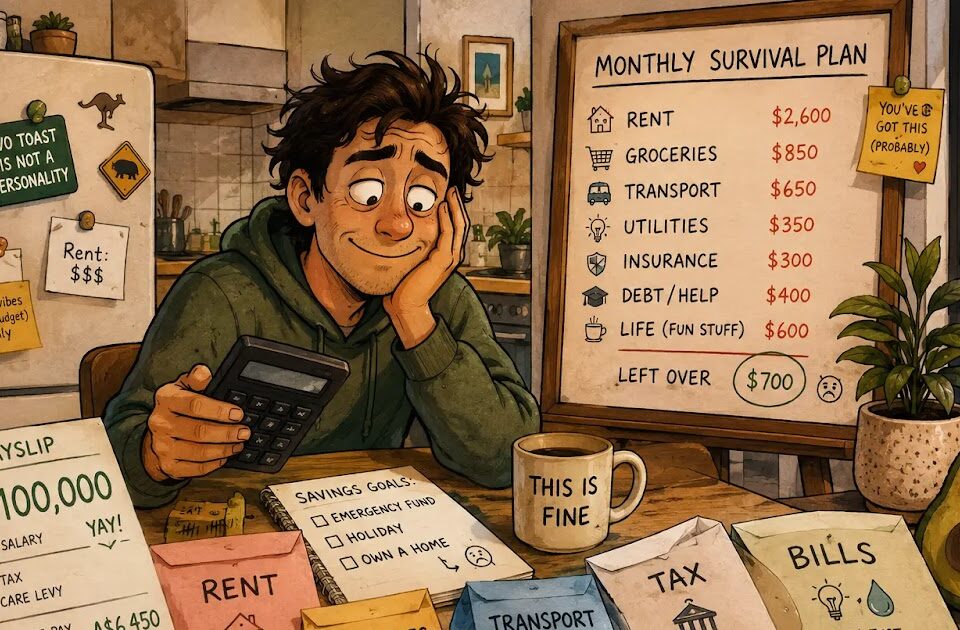
Simple cash-flow visual
The real budget villains
The Australian squeeze usually comes from the big, boring costs:
| Cost | Why it hurts |
|---|---|
| Rent or mortgage | Often the biggest monthly hit |
| Groceries | Somehow a small basket now feels like a luxury item |
| Transport | Fuel, rego, insurance, parking, public transport |
| Utilities | Electricity bills with main-character energy |
| Debt | Credit cards, car loans, HECS/HELP, personal loans |
| Insurance | Necessary, but rarely cute |
| Lifestyle creep | The quiet upgrade from “basic” to “premium everything” |
The problem is not always reckless spending. Sometimes the maths is simply tight. A person can earn well and still feel squeezed if fixed costs swallow the pay before savings get a turn.
Quick comparison: U.S. vs Australia
| Topic | U.S. cash-poor version | Australian version |
|---|---|---|
| Main issue | Good income, weak savings | Good income, high fixed costs |
| Big pressure | Housing, debt, healthcare | Housing, rent, tax, groceries, transport |
| Salary shock | Six figures no longer feels rich | A$100k can feel normal in expensive cities |
| Emotional mood | “Why am I broke?” | “Why did groceries need a board meeting?” |
| Lesson | Income is not security | Cash flow decides comfort |
A mini A$100k renter scenario
Imagine a single renter earning A$100,000 before tax.
| Monthly item | Example cost |
|---|---|
| Take-home pay | A$6,450 |
| Rent | A$2,600 |
| Groceries | A$850 |
| Utilities, phone, internet | A$350 |
| Transport | A$650 |
| Insurance and health costs | A$300 |
| Debt or HECS/HELP pressure | A$400 |
| Eating out, clothes, gifts, life admin | A$600 |
| Left before serious savings | A$700 |
A$700 left is not disaster. But it is not luxury either. One car repair, bond increase, dental bill, or laptop death can turn “I am doing fine” into “I am eating cereal with emotional support.”
When six figures still works well
A six-figure salary can still be powerful when housing is controlled, debt is low, transport is manageable, and savings are automatic. It feels strongest when the person has room between income and fixed costs.
It feels weakest when rent, mortgage repayments, lifestyle creep, and debt eat the pay rise before it even gets comfortable.
Final verdict
A six-figure salary in Australia is still worth celebrating. But it is not a magic wand.
The U.S. “cash-poor” story and the Australian A$100k squeeze both teach the same lesson: salary is only the headline. What matters is what remains after rent, tax, groceries, transport, bills, and life’s random little financial jump scares.
So yes, A$100k is good money. Just check the rent renewal before popping the champagne.
“`
FAQs
Is A$100k a good salary in Australia?
Yes, A$100k is a good salary for many Australians, but comfort depends heavily on location, housing costs, debt, and family responsibilities.
Why can someone on six figures still feel broke?
Because fixed costs can absorb most of the income. Rent, mortgage payments, transport, debt, insurance, and groceries can leave little room for savings.
Is Australia’s cost-of-living problem the same as the U.S.?
Not exactly. The systems are different, especially around healthcare and tax, but both countries show the same broad issue: a strong salary does not always create financial security.
By: Iris Cruz
About the author: Iris Cruz writes practical accounting and economics explainers for general readers.
Last updated: 2026-07-08
Disclosure: Educational commentary only, not personal financial advice.
Disclaimer
This article is general educational commentary for Australian readers. It does not consider your personal income, debts, tax position, family situation, or financial goals.
References